
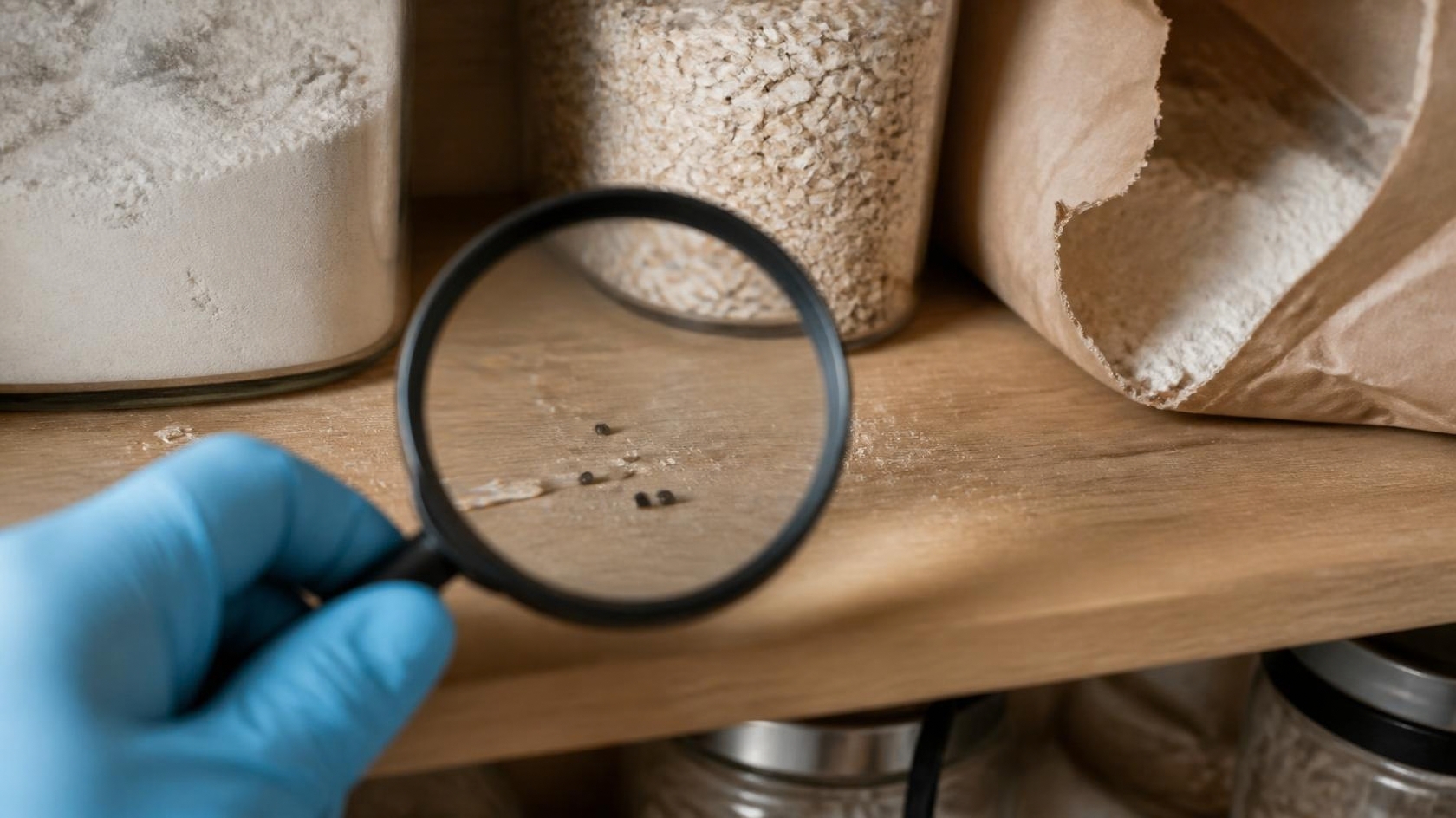
Finding small dark pellets near your baseboards or in a kitchen cabinet is unsettling. Rodents invade an estimated 21 million U.S. homes each winter, yet most homeowners don’t know what they’re looking at. Knowing how to identify pests by their droppings can save you from misdiagnosis, wasted money, and real health risks.
Introduction
Pest droppings are often the first visible sign of an infestation. A homeowner might spot dark specks near a pantry shelf or along a wall and assume the worst, or dismiss them entirely. Neither reaction serves you well without accurate identification.
Getting the identification right matters before any treatment begins. The EPA’s Integrated Pest Management framework is explicit on this point: identify the pest accurately first, then decide on a control strategy. Skipping that step can mean applying the wrong treatment entirely.
Droppings vary significantly by species in size, shape, texture, and location. Those differences are diagnostic clues. Recognizing them gives you, and any pest management professional you call, a meaningful head start on resolving the problem quickly and safely.
Why Dropping Identification Matters Before You Call an Exterminator
Accurate identification protects your budget and your health. According to the EPA, IPM programs “work to monitor for pests and identify them accurately so that appropriate control decisions can be made,” specifically because accurate identification “removes the possibility that pesticides will be used when not really needed, or that the wrong kind of pesticide will be used.”
The stakes are real. Termites cause more than $6.8 billion in property damage annually in the U.S., damage that homeowners insurance does not cover, and ants are frequently mistaken for termites. Correct dropping and frass identification is the earliest, cheapest way to distinguish them, according to the NPMA.
Dropping identification helps you in several concrete ways:
- Confirms pest type: Different species leave distinctly different evidence, narrowing the field before a professional inspection.
- Signals infestation severity: Volume, freshness, and distribution of droppings all indicate how established a pest pressure problem is.
- Guides treatment selection: The EPA’s four-step IPM sequence, identify, monitor, set action thresholds, then control, depends on correct identification at step one.
- Prevents wasted spending: Treating for the wrong pest delays resolution and adds unnecessary cost.
Rodent Droppings: Rats vs. Mice Side by Side
Rats and mice leave distinctly different droppings: rat droppings are larger and deposited in clusters at fixed latrine sites, while mouse droppings are smaller, pointed on both ends, and scattered randomly. Size, shape, and deposition pattern all differ by species, making droppings one of the most reliable indicators of which rodent is present.
Norway Rat Droppings
Norway rat droppings measure approximately 3/4 inch long with blunt, capsule-shaped ends. They are the largest of the common rodent droppings and are typically found in clusters at established “latrine” sites rather than scattered randomly.
Norway rats favor ground-level areas: basements, crawl spaces, and the perimeter of a facility near loading docks or dumpsters. Fresh droppings are dark, moist, and shiny; older ones turn gray and crumble easily.
Roof Rat Droppings
Roof rat droppings measure approximately 1/2 inch long with tapered, spindle-shaped ends, making them noticeably more pointed than Norway rat pellets. Roof rats travel elevated routes, so sightings tend to occur along rafters, in attics, and near upper-level entry points on the exterior of a structure.
Their droppings are also deposited in clusters at regular latrine sites. Rats collectively produce 20 to 50 droppings per day, according to the CDC.
House Mouse Droppings
House mouse droppings measure 1/8 to 1/4 inch with pointed ends on both sides, resembling dark grains of rice. A single house mouse produces 50 to 75 droppings per day, scattered randomly along baseboards and in food storage areas, per the NPMA.
Cleaning an area and finding new droppings within 24 to 48 hours is definitive evidence of an active infestation. The high daily output and random scatter pattern are the clearest behavioral differences from rat species.
Insect Droppings: Cockroaches, Bed Bugs, and More
Insect droppings require closer inspection than rodent evidence. They are smaller, easier to overlook, and carry their own serious health implications. Early identification reduces both pest pressure and health risk.
Cockroach Droppings
German cockroach droppings look like black pepper or coffee grounds, measuring under 1 to 2 mm. They appear at cabinet hinges, behind appliances, and along wall junctions. American cockroach droppings are larger, 3 to 4 mm, and cylindrical with ridges running lengthwise. Those ridges are the key differentiator from mouse droppings, which are smooth.
The National Institute of Environmental Health Sciences reports that 1 in 5 children in the U.S. have severe sensitivities to cockroach allergens introduced through droppings and decomposing bodies.
Cockroach droppings also contain pheromones that actively attract more roaches, according to the NPMA. Early cleanup is not just a hygiene step. It is a population-control measure.
Bed Bug Droppings
Bed bug droppings appear as tiny ink-like dots or smears, approximately 1 mm, dark rusty-brown to black. They bleed into fabric rather than sitting on top of it. A reliable field test: rub a damp cotton swab over the spot. Bed bug droppings smear into a dark reddish-brown streak because of the iron content from digested blood.
According to a 2025 Harris Poll and NPMA survey of 2,099 U.S. adults, only 29% of Americans can correctly identify bed bugs, which explains why infestations often go undetected until they are well established.
Common Look-Alikes: What Gets Mistaken for Pest Droppings
Not every dark speck is a pest dropping. Misidentification leads to unnecessary treatments or missed infestations. The most reliable distinguishing features are:
- White tip = lizard: Lizard feces are elongated pellets, 5 to 10 mm, with a distinctive white uric acid cap at one end. Rodent droppings never have this white tip.
- Ridges = cockroach: Cockroach pellets have ridges running along their length. Mouse droppings are smooth with pointed ends.
- Crumbles to shiny powder = bat guano or termite frass: Bat guano crumbles into powder with visible insect wing fragments when pressed. Mouse droppings stay hard and fibrous.
- Six-sided uniform pellets near wood = drywood termite frass: Termite frass appears in neat piles near wood exit holes, not near food or water sources, per the EPA.
- Irregular crumbs near food = not pest droppings: Food debris, construction dust, and spilled seeds are frequently mistaken for pest evidence. Location and shape together rule these out.
Wildlife Droppings: Squirrels and Bats in the Home
Wildlife droppings in an attic or wall cavity carry higher health stakes than most insect evidence. Correct identification here is genuinely important before any cleanup begins.
Squirrel droppings are oblong pellets, approximately 3/8 inch long and 1/8 inch in diameter, with rounded tips and a slightly bulging center. Fresh droppings are dark brown to black and may contain visible bits of undigested nuts or seeds.
Flying squirrels can colonize in groups of 12 to 30 animals in a single attic, according to industry wildlife data. Finding more than 10 to 15 droppings in a confined space suggests an active infestation requiring professional intervention.
Bat guano presents a more serious health concern. Pellets from common house-roosting species run 6 to 12 mm long, elongated and slightly curved, and crumble into shiny powder with visible insect wing fragments when pressed. The CDC links accumulated bat guano to histoplasmosis, a fungal lung infection.
“60 to 90% of people in the Mississippi and Ohio River Valley areas have been exposed to Histoplasma in their lifetime.” – CDC
Large guano accumulations should be handled by professionals. Bat colony exclusion in the U.S. costs $1,000 to $6,000 or more, according to Angi, making early identification a meaningful cost-avoidance tool.
Conclusion
Pest droppings are diagnostic evidence, not just a nuisance. Size, shape, texture, and location each narrow the field toward a specific pest, and that identification shapes every treatment decision that follows. Acting on accurate information protects both property and public health.
Whether the concern is rodents near a food storage area, cockroach evidence behind kitchen appliances, or wildlife in an attic, the pattern is the same: inspect carefully, identify accurately, and engage a qualified pest management professional before conditions worsen. Early action consistently produces better outcomes than delayed response.
Frequently Asked Questions
How much does professional pest dropping identification cost in the United States?
Most pest management companies in the United States include a dropping inspection as part of a standard initial inspection visit, which typically costs $75 to $150 depending on the region and property size. Some providers offer free inspections for specific pest types.
Squirrel removal, once confirmed, averages $500 to $1,500 nationally. Bat colony exclusion is the most expensive wildlife scenario, often reaching $1,000 to $6,000 or more depending on colony size and access.
How dangerous are rodent droppings to people in the United States?
Rodent droppings pose serious health risks. The CDC documents that Hantavirus Pulmonary Syndrome, transmitted through aerosolized deer mouse droppings, carries an overall case fatality rate of approximately 35 to 38%, with 890 confirmed U.S. cases recorded since 1993.
Rodents are also linked to more than 35 documented human diseases spread through droppings, urine, and contaminated food. Enclosed spaces with accumulated droppings carry the highest exposure risk.
How do I safely clean up pest droppings without spreading contamination?
Never sweep or vacuum rodent droppings. That action aerosolizes infectious particles. The CDC recommends ventilating the area for at least 30 minutes before entering and wearing rubber gloves and an N95 respirator for heavy cleanup.
Spray droppings with a bleach solution (1 part bleach to 9 parts water), soak for 5 minutes, then wipe up with paper towels. Double-bag all waste before disposal.
How do cockroach droppings compare to bed bug droppings?
Cockroach droppings are dry pellets with ridges running lengthwise, found near appliances and cabinet hinges. Bed bug droppings are liquid smears that bleed into fabric and test reddish-brown when rubbed with a damp swab.
Cockroach allergen sensitization reaches 60 to 80% of inner-city children living with asthma, per the NIEHS, making cockroach evidence a public health concern beyond simple pest pressure. Bed bug droppings are not known to spread disease but do signal active infestation.
What should I do first if I find unidentified droppings in my home?
Do not handle the droppings without gloves. Photograph them next to a coin or ruler for scale, then note the location, quantity, and whether they appear fresh or dried. The EPA’s Integrated Pest Management framework recommends professional identification as the foundation of any effective treatment plan.
A qualified pest management professional can confirm species through microscopic examination or laboratory testing if visual identification is inconclusive, making sure the right treatment is applied from the start.